Verbal Ability
47questions
Professional and Subprofessional
- Word meaning · 5
- Sentence completion · 7
- Error recognition · 8
- Sentence structure · 9
- Paragraph organization · 8
- Reading comprehension · 10
Free download · No account needed
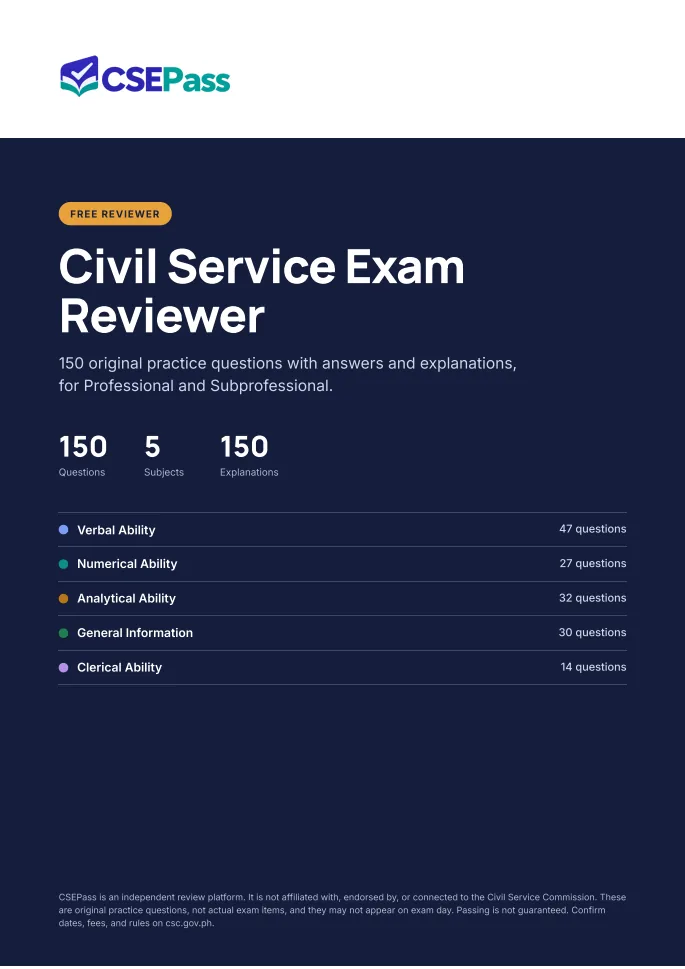
150 original practice questions with answers and explanations, for both Professional and Subprofessional. Download it, print it, and review offline.
PDF, 1.9 MB. Updated 18 November 2026. We email you the link.
Free · No account needed
Six short emails before 14 March 2027, each with one thing to do next.
What's inside
47questions
Professional and Subprofessional
27questions
Professional and Subprofessional
32questions
Professional
30questions
Professional and Subprofessional
14questions
Subprofessional
Look inside
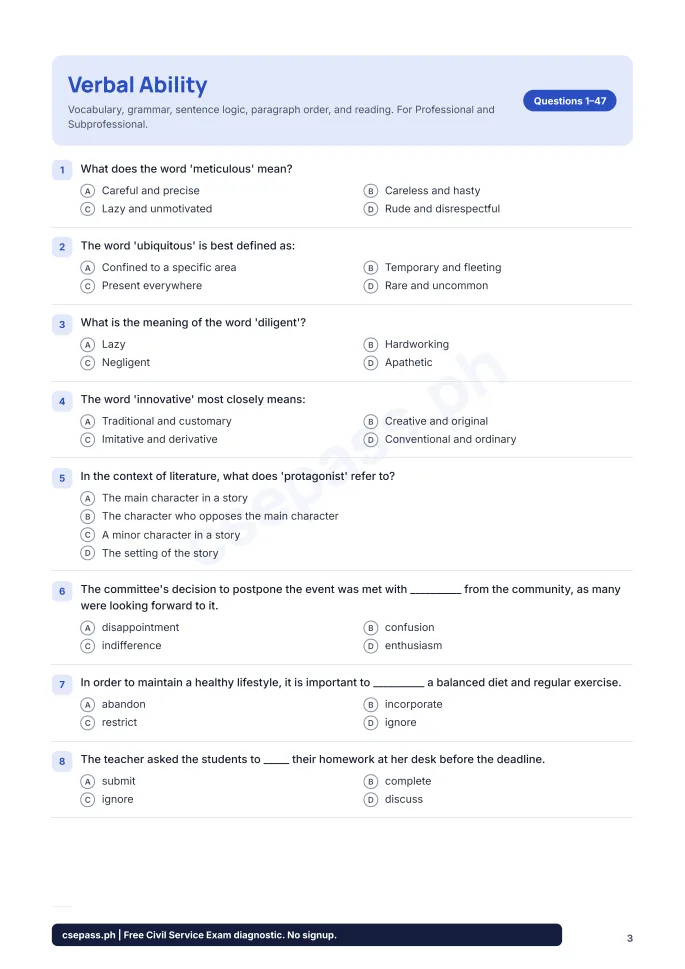
Preview
Answer: A. Careful and precise "Meticulous" means paying close attention to detail, so careful and precise is correct. "Careless and hasty" is the opposite, since a meticulous person does not rush or overlook things. "Lazy and unmotivated" describes low effort, and "rude and disrespectful" describes manners, not thoroughness.
Answer: C. Present everywhere "Ubiquitous" means present or found everywhere at once, so present everywhere is correct. "Confined to a specific area" is the opposite, since a ubiquitous thing is not limited to one place. "Rare and uncommon" fails for the same reason, and "temporary and fleeting" describes how long something lasts, not where it is.
Answer: D. 502 Add the columns: 4 + 8 = 12 (write 2, carry 1), 2 + 7 + 1 = 10 (write 0, carry 1), and 1 + 3 + 1 = 5, which gives 502. 498 is tempting but falls 4 short of the true sum.
Answer: D. PHP 750 Subtract the amount spent from the money on hand: 1,200 − 450 = ₱750. ₱800 is tempting as a rounder number, but it would mean spending only ₱400 on groceries rather than ₱450.
Answer: D. 15 To find the median, arrange the numbers in order and identify the middle value. The sorted data set is 5, 10, 15, 20, 25. The median is 15, the third number in the list.
Answer: D. 60% Subtract the initial value from the final value, divide by the initial value, and multiply by 100: ((80,000 − 50,000) ÷ 50,000) × 100 = 60%.
Answer: A. Congress, a constitutional convention, or the people through initiative Congress, a constitutional convention, or the people through initiative may propose changes: Article XVII, Section 1 names Congress, by three-fourths of all its Members, and a convention, and Section 2 adds initiative. The Senate, by its own vote, at the request of the President fails because Section 1 requires Congress, not the Senate alone.
Answer: B. It divides the government into Executive, Legislative, and Judicial branches, each with distinct functions and powers. The principle of separation of powers is fundamental to the structure of the Philippine government, ensuring that the Executive, Legislative, and Judicial branches operate independently and check each other's powers.
Answer: C. rescind Rescind means to take back or cancel, and it is spelled with sc: r-e-s-c-i-n-d. Resind and recind drop a letter, while resend is a real word with a different meaning, to send again.
Answer: A. colleague Colleague, a fellow member of a team or workplace, is spelled with a double l and the ending -ague. Collegue is the tempting error because it leaves out the a before the final -gue.
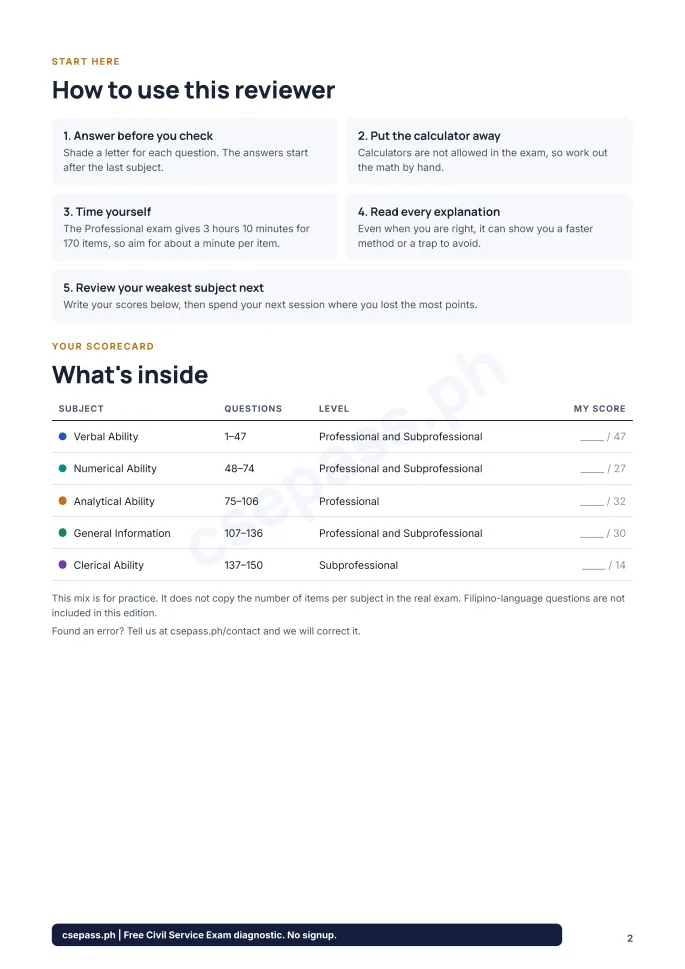
Study plan
Session 1
Questions 1–47
About 47 minutes
Session 2
Questions 48–74
About 27 minutes
Session 3
Questions 75–106
About 32 minutes
Session 4
Questions 107–136
About 30 minutes
Session 5
Questions 137–150
About 14 minutes
Answer before you check. Shade your answer on the page, or use a separate sheet so you can retake it.
Work out the math by hand, because calculators are not allowed in the exam.
Time yourself at about a minute per question.
Read every explanation, even when you are right, then spend your next session on your weakest subject.
The real exam
Filipino questions are not in this edition, although Verbal Ability is tested in English and Filipino. See the full exam coverage for every topic.
These are original practice questions, not actual exam items, and they may not appear on exam day. CSEPass is independent and is not affiliated with the Civil Service Commission. The CSC says it does not publish or accredit any review material, so be careful with any reviewer that claims otherwise. Found an error? Tell us and we will correct it.
FAQ
Yes. Enter your email and we send you the download link right away. No account or payment needed, and you may print it for your own review.
No. They are original practice questions written for CSEPass. They may not appear on exam day. The CSC does not publish or accredit review material, so be careful with any reviewer that claims to be official or to have leaked questions.
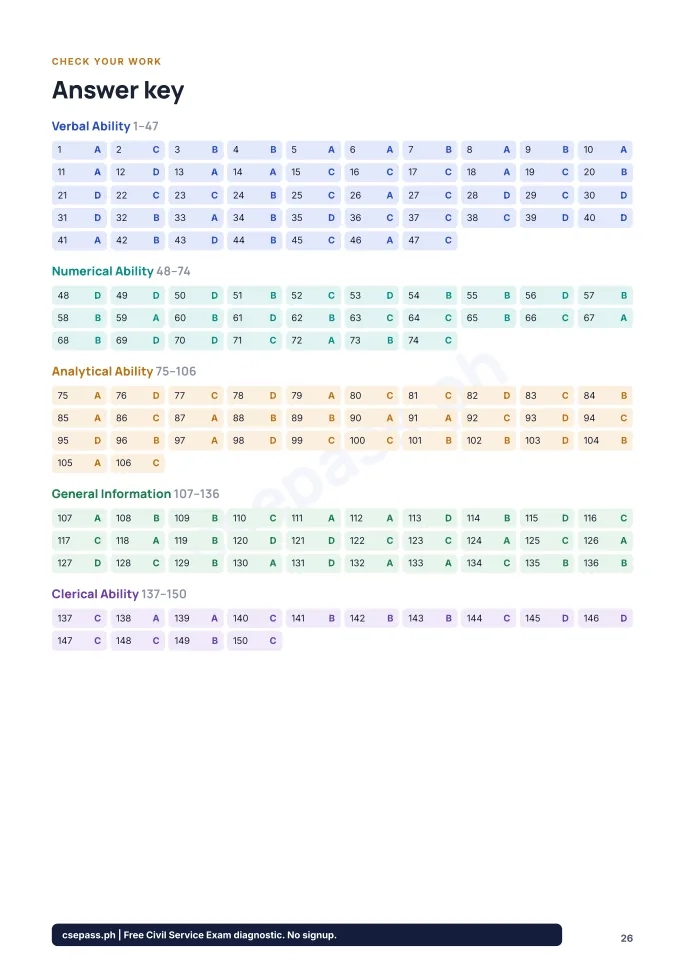
Yes. Every question has its answer and an explanation in the answer section at the back. General Information answers also name the law or document they rest on.
Both. Verbal, Numerical, and General Information apply to both levels. Analytical Ability is for Professional, and Clerical Ability is for Subprofessional.
No. The mix is for practice, and it is shorter than the real exam. Use a timed mock when you want to practice your pacing.
At about a minute per question, all 150 take about 2.5 hours. It's easier to split them into shorter sessions and review your mistakes after each one.
Yes. It opens in any PDF reader. Printing is better if you want to shade answers by hand or practice without your phone.
No reviewer can promise a pass, and 150 questions don't cover everything. Use the PDF to find your weak subjects, then keep practicing those topics and try a timed mock.
We chose questions that passed our independent checks, in which answers were worked out without first seeing the key. Those checks used AI tools and our own reading, and the questions aren't reviewed by the CSC. If you spot an error, please tell us.
Not in this edition. Verbal Ability is tested in English and Filipino, so also practice Filipino vocabulary and grammar.
Take the free diagnostic to see your weak topics, or try more sample questions online.